
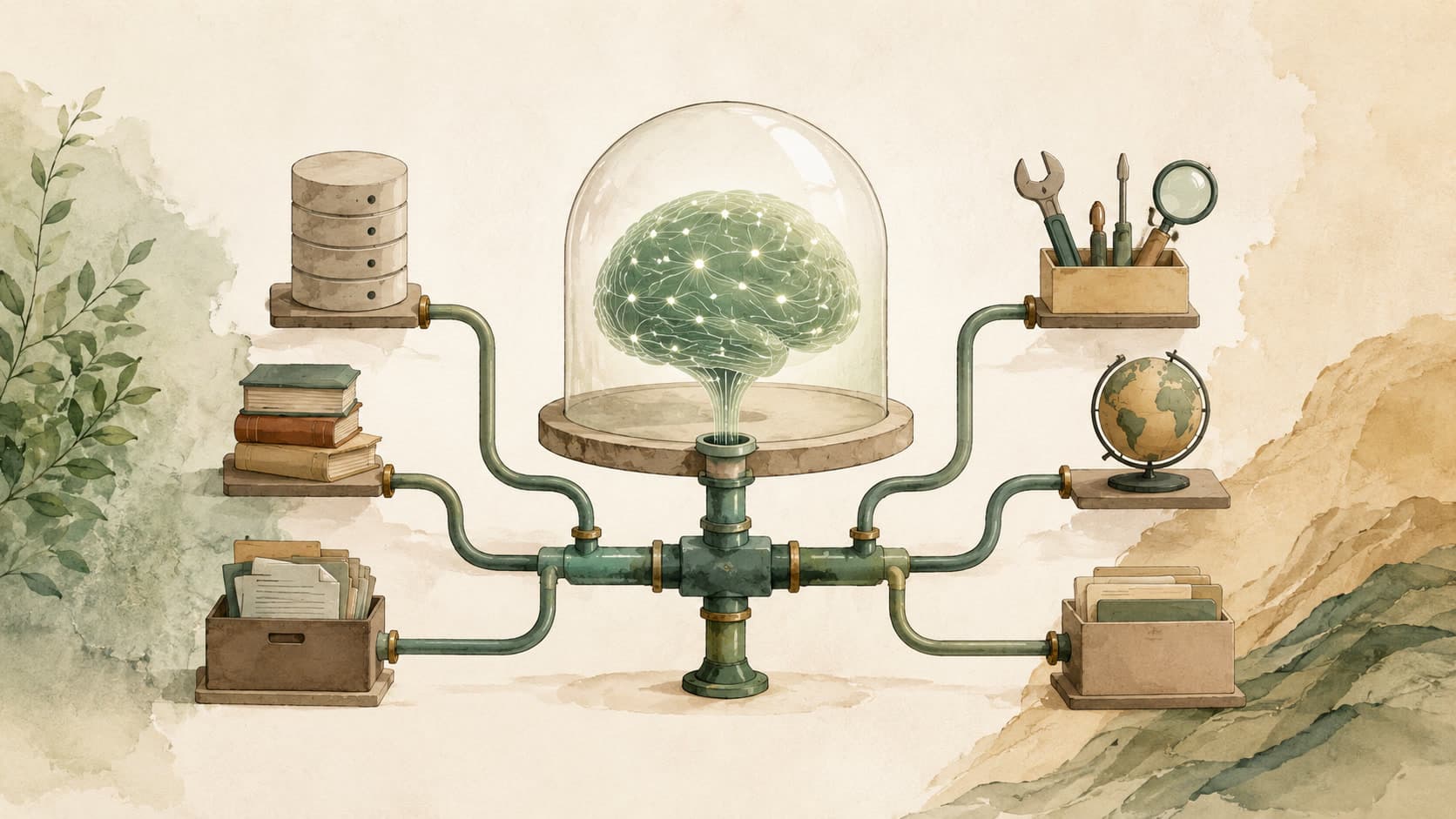
MCP is the protocol that lets an AI client talk to outside tools and data sources without each pairing being a bespoke integration. It is, more than anything, a connector standard, USB for context.
In plain language
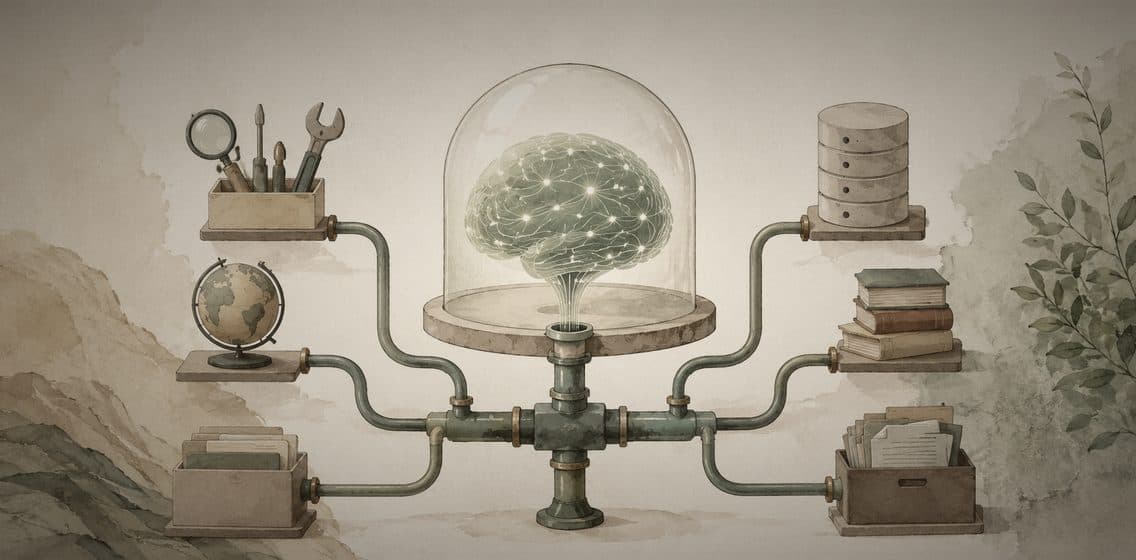
Think of MCP as USB for AI assistants. Before USB, every printer needed its own cable and driver; afterwards, one plug worked everywhere. A plain Chatbot only has to answer you, but an AI Agent wants to act, and acting means reaching tools, usually through a separate API for each one. MCP plays that role for the tools an AI might want to use, your calendar, your code editor, a database, so the model does not need bespoke API code to reach each one. It is a protocol, not a model.
An everyday picture
Think of MCP less like a thinking person and more like someone who has read an enormous amount and now finishes other people's sentences for a living. They have absorbed the shape of the work; they have not memorised any one page.
Where it shows up
MCP tends to sit inside products that need to read, write, or recognise without a hard-coded rule, assistants, search, document tools, voice apps. It is rarely the only moving part, but it is often the part the user feels.
A small example
Claude Desktop uses MCP to read files in a chosen folder. The folder is exposed by a small MCP server; Claude reaches it through the same protocol it would use for a database or a calendar.
Common misunderstanding
One line to take with you
MCP is statistics worn well. Useful for patterns; double-check it for facts.
Frequently asked
Neither. MCP is a protocol, a shared set of rules for how an AI client and an outside tool talk to each other. It does not think, answer, or generate text on its own, and it is not a product you download. What you actually run is an MCP server, a small program that wraps one tool or data source (a folder, a database, a calendar) and exposes it in the MCP format, and an MCP client built into something like Claude Desktop or a code editor. The model stays the same model; MCP is just the agreed-upon plug between it and the tool.
A chatbot only has to answer, but an agent wants to act, read a file, query a database, send a calendar invite, and each of those used to need its own hand-written integration for every model. That work multiplied: every new tool times every model. MCP collapses that into one interface, so a tool maker writes a single MCP server and any MCP-aware client can use it, and adding a tool no longer means re-teaching the model. For agents this is the difference between a closed assistant and one that can reach the systems where real work happens, which is why MCP is often described as a USB-C moment for AI tooling.
MCP is a channel, not a permission system, so the access flowing through it is something a person has to decide. Start by trusting the server itself the way you would any program: prefer official or open-source servers you can inspect, since a malicious one can act with whatever access you grant it. Then scope that access narrowly, give a filesystem server one folder rather than your whole home directory, and read-only where reading is enough. Keep a human approval step for actions that change or send data, watch for prompt-injection where text the model reads tries to trigger tool calls you did not intend, and never hand secrets like API keys to a server you have not vetted. The core question at setup time is simple: what can this server do, and how is the user asked before it does it.