
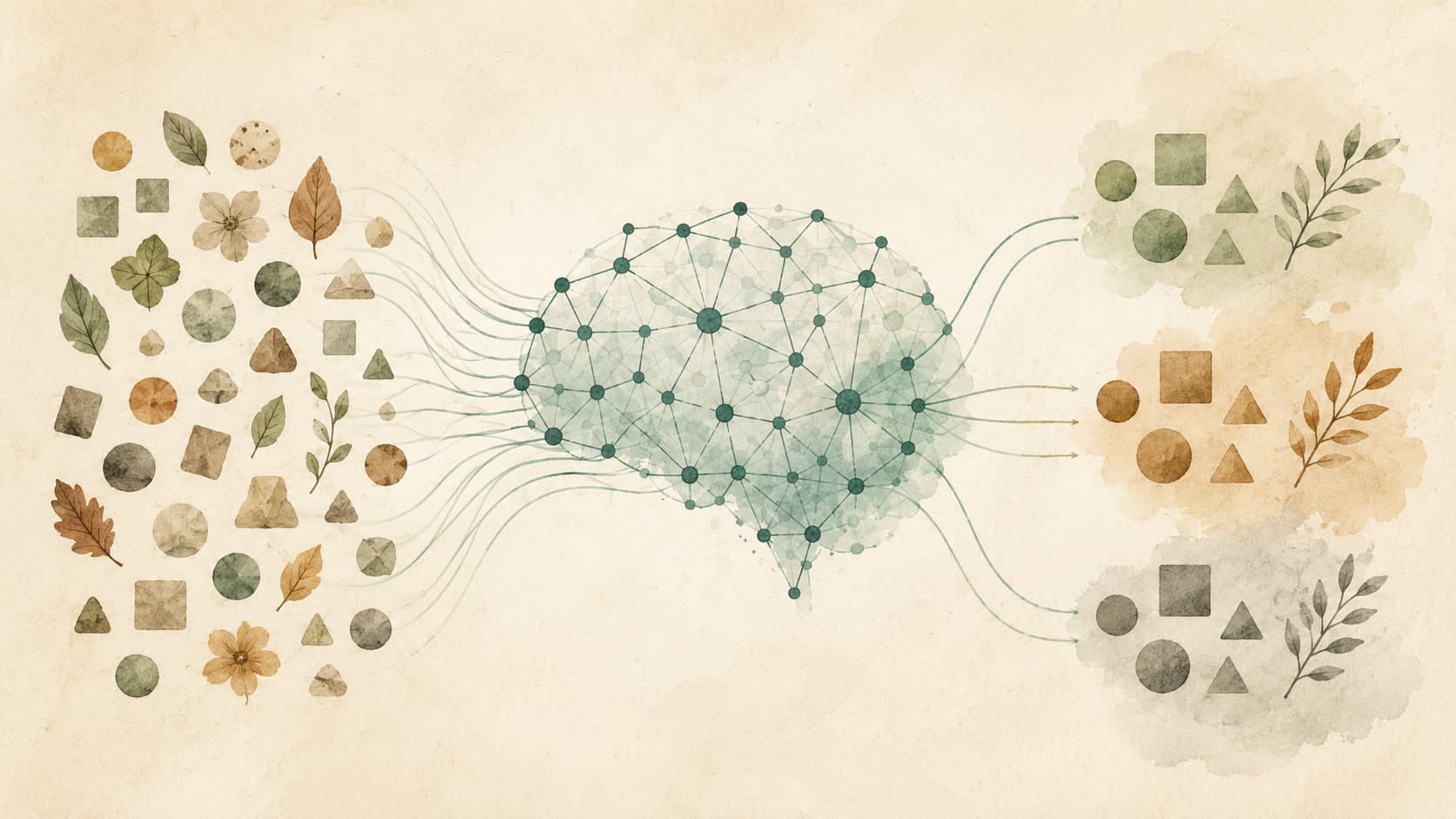
- Machine learning is a type of artificial intelligence where computers learn to make decisions from data, rather than following explicitly written rules.
- ML powers everyday tools like spam filters, recommendation engines, voice assistants, and fraud detection systems.
- You don't need to be a data scientist to benefit from machine learning — it already runs quietly behind many apps and services you use daily.
What is Machine Learning?
Machine learning (often abbreviated as ML) is a branch of artificial intelligence (AI) in which a computer system learns to make decisions or predictions by analyzing large amounts of data — rather than by following a set of hand-coded rules written by a programmer.
In traditional programming, a developer writes specific instructions: "If X happens, do Y." Machine learning flips this: instead of being told the rules, the computer finds the patterns itself by looking at thousands or millions of examples.

A Real-World Analogy
Imagine teaching a child to recognize a dog. You don't hand them a textbook with the exact height, weight, and fur specifications of every dog breed. Instead, you show them many pictures: "That's a dog. That's also a dog. That's a cat, not a dog." After seeing enough examples, the child can identify a dog they've never seen before.
Machine learning works the same way. You feed the computer thousands of labeled examples (called training data), and over time it figures out what patterns lead to which outcome. Eventually, it can make accurate predictions on new data it has never encountered.
Why Does Machine Learning Matter?
Machine learning matters because it can handle tasks that are too complex, too large, or too fast-changing for humans to write explicit rules for. Key reasons it's important:
- Scale: ML can analyze millions of data points in seconds — far beyond human capacity.
- Adaptability: ML models can improve over time as they see more data, without needing manual reprogramming.
- Discovery: ML can find hidden patterns in data that humans might never notice.
- Automation: Repetitive, pattern-based tasks — like sorting emails or detecting fraud — can be automated with high accuracy.
For businesses, machine learning enables smarter customer experiences, better fraud protection, and more efficient operations.
How Machine Learning Works
The general process looks like this:
- Collect data: Gather a large dataset relevant to the problem (e.g., thousands of past emails labeled "spam" or "not spam").
- Train the model: Feed the data into an ML algorithm. The algorithm finds statistical patterns between the input (email content) and the label (spam or not).
- Test and evaluate: Test the model on new data it hasn't seen to check its accuracy.
- Deploy: Once it performs well enough, the model is put into production — it now makes predictions on real, live data.
- Improve: As new data comes in, the model can be retrained to stay accurate.
There are several types of machine learning:
- Supervised learning: The model is trained on labeled examples (most common).
- Unsupervised learning: The model finds patterns in unlabeled data (e.g., customer segmentation).
- Reinforcement learning: The model learns by trial and error, earning rewards for good decisions (used in game-playing AI and robotics).
Common Machine Learning Examples
| Application | How ML Is Used |
|---|---|
| Email spam filter | Learns from millions of emails to classify spam vs. legitimate mail |
| Netflix recommendations | Suggests shows based on what users with similar taste watched |
| Voice assistants (Siri, Alexa) | Recognizes and interprets spoken language |
| Fraud detection | Flags unusual transaction patterns in real time |
| Image recognition | Identifies objects, faces, or defects in photos |
| Search engine results | Ranks pages based on predicted relevance to your query |
Key Takeaway
Machine learning is how computers teach themselves from examples rather than instructions. It's the engine behind many tools and services that feel almost magical — spam filters that know what you don't want to read, recommendations that feel uncannily accurate, and voice assistants that understand natural speech.
ML is already woven into daily life, and its role is only growing. Understanding the basics helps you make sense of the AI-powered world around you.
Related Terms
- Artificial Intelligence (AI) — The broader field that includes machine learning, covering any system that simulates human intelligence.
- Deep Learning — A more advanced subset of machine learning that uses neural networks inspired by the human brain.
- Cloud Computing — Most ML models are trained and run on powerful cloud servers, making the technology accessible to smaller teams.
- API — ML models are often delivered as APIs so developers can add intelligence to any app.
- SaaS — Many ML tools are available as SaaS products, letting businesses use AI without building models themselves.
Sources
- IBM — "What is Machine Learning?": A comprehensive, accessible overview of ML concepts and applications from a major technology company. (ibm.com)
- Google — Machine Learning Crash Course: A free beginner resource covering ML fundamentals with interactive examples. (developers.google.com)
- MIT Technology Review — Machine Learning: Covers real-world ML applications and research in accessible language for general readers. (technologyreview.com)