
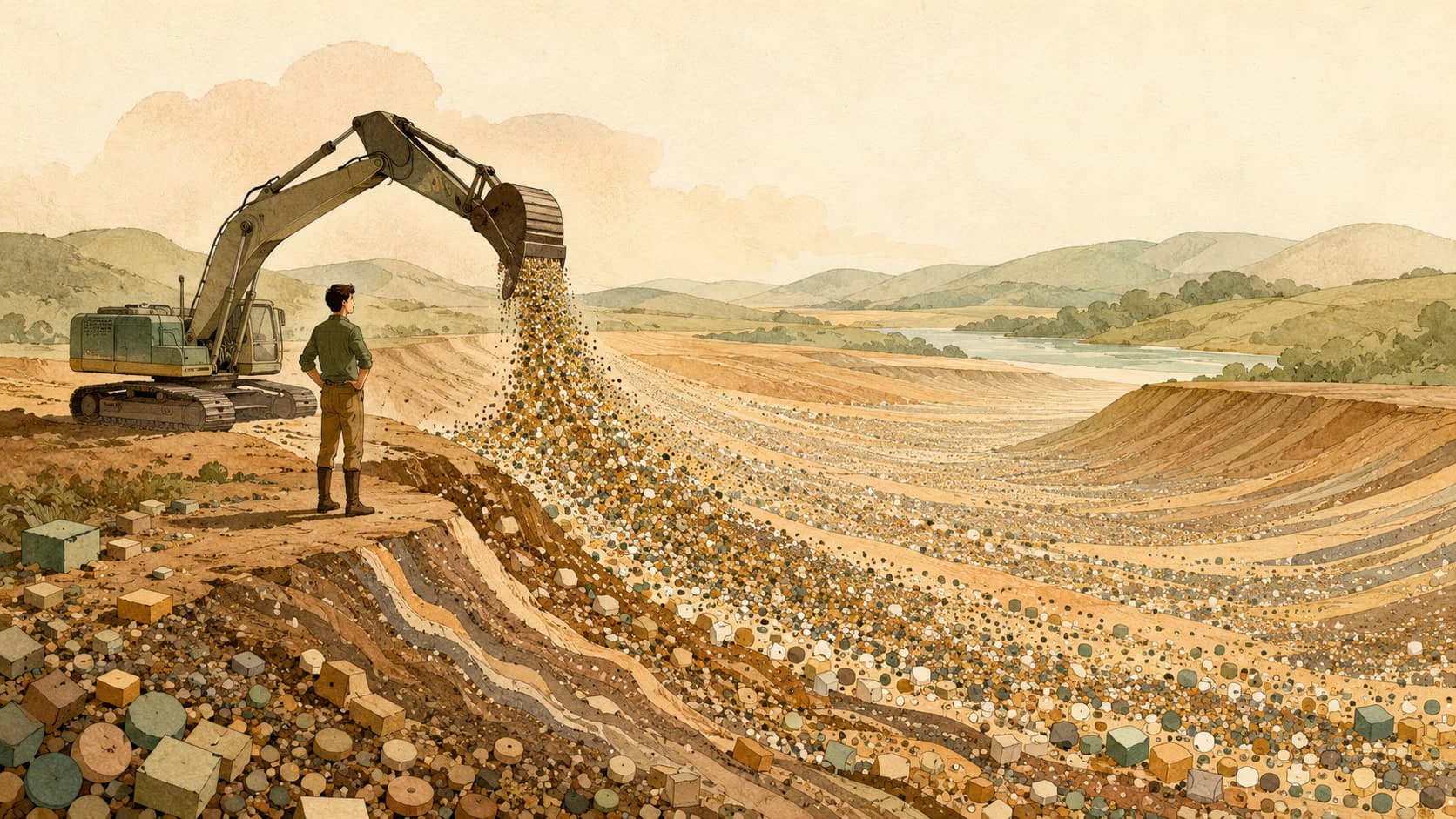
- Big Data describes information that is too large, too fast, or too varied for traditional spreadsheets and databases to handle on their own.
- It is often summarized by the "three Vs" — Volume, Velocity, and Variety — first popularized by analyst Doug Laney in 2001.
- Big Data only creates value when it is collected carefully, stored on systems that can scale, and turned into clear answers to real business questions.
What is Big Data?
Big Data is a term for collections of information that are too large, too fast-moving, or too varied for ordinary tools like a single spreadsheet or a single database server to handle. Instead of a few thousand rows in a file, think of billions of website clicks, sensor readings, credit-card transactions, video views, or social-media posts arriving every day from many different sources at the same time.
The phrase became popular in the early 2000s. In a short 2001 research note, analyst Doug Laney described the challenge of managing data along three dimensions: Volume (how much), Velocity (how fast), and Variety (how many different types). Later writers added more "Vs" such as Veracity (how trustworthy) and Value (how useful), but the core idea is the same: when data outgrows the tools you used yesterday, you need a different approach.

A Real-World Analogy
Think of Big Data like the traffic in a large city. On a quiet country road, one person with a clipboard can sit by the side of the road and count every car that passes. They might even write down the color and direction. The data is small, slow, and simple.
Now imagine trying to do the same thing for an entire city — every intersection, every highway, every parking lot, twenty-four hours a day. No human (or even a small team) can count fast enough or remember enough. Instead, the city installs cameras, road sensors, GPS feeds, and bus trackers, and then sends all of that information into computers that can summarize what is happening in real time. The clipboard worked perfectly fine for the country road, but a city needs a completely different system. Big Data is what happens when an organization's information starts to look more like the whole city than the single road.
Why Does Big Data Matter?
Big Data matters because patterns that are invisible in small data sets often become visible at large scale. A single store may not notice that customers who buy umbrellas often buy a particular kind of coffee, but a national retailer with millions of receipts can spot that pattern and use it to plan promotions, inventory, and store layouts. Streaming services use viewing data from many millions of accounts to decide what shows to recommend or produce. Banks use enormous transaction logs to flag suspicious activity within seconds. Hospitals use combined records to study which treatments work best for which kinds of patients.
For a small business, the term can feel like it belongs only to giant tech companies, but the underlying lesson is broader. Even a small shop that starts collecting online orders, loyalty-card visits, and customer reviews will eventually outgrow a single spreadsheet. Knowing what Big Data is helps owners and managers ask better questions about which data is worth keeping, which tools they will need next, and which decisions should be informed by numbers rather than guesses.
How It Works
Working with Big Data usually involves four broad steps. First, data is collected from many sources — apps, websites, sensors, point-of-sale systems, partner feeds, and so on. Second, it is stored on systems designed to grow easily, such as cloud storage or distributed file systems like Hadoop's HDFS. Third, it is processed and cleaned using engines such as Apache Spark, which can split a large job across many computers at once. Finally, the cleaned data is analyzed and visualized so that people, dashboards, or machine-learning models can use it to make decisions.
A key idea behind all of this is horizontal scaling: rather than buying one very large, very expensive computer, organizations connect many ordinary computers together and share the work between them. This makes it possible to handle datasets that would have been unthinkable a couple of decades ago.
Common Examples
| Industry | Type of Big Data | What It Helps Decide |
|---|---|---|
| Retail | Online clicks, receipts, loyalty cards | Pricing, promotions, store layout |
| Streaming media | Viewing history, ratings, search terms | Recommendations and new content |
| Banking | Transaction logs, login patterns | Fraud detection and risk scoring |
| Healthcare | Combined patient records, sensor data | Treatment effectiveness and public-health trends |
| Transportation | GPS traces, road sensors, ride requests | Routing, demand forecasting, traffic flow |
Key Takeaway
Big Data is not just "a lot of data" — it is data large enough, fast enough, or messy enough that you need different tools and habits than a simple spreadsheet provides. Volume, Velocity, and Variety are useful words for noticing when you have crossed that line. The point is never the size by itself, but the questions it lets you answer. A clear question, a trustworthy data set, and a tool that can scale with you will almost always beat a huge pile of data with no plan attached.
Related Terms
- Cloud Computing — Renting storage and computing power over the internet, which is where most Big Data systems now live.
- Database — An organized system for storing structured information, often the starting point before data grows into Big Data.
- Data Analytics — The practice of examining data sets to draw useful conclusions, the activity Big Data is meant to support.
- Machine Learning — Software that learns patterns from data; modern machine learning often depends on Big Data inputs.
- Hadoop — An open-source framework, important in Big Data history, for storing and processing data across many machines.
Sources
- Doug Laney, "3D Data Management: Controlling Data Volume, Velocity and Variety" (META Group / Gartner research note, 2001) — the original short note that introduced the "three Vs" framing still used today.
- IBM, "What is big data?" overview at ibm.com/topics/big-data — a vendor-friendly explainer that defines Big Data and its core characteristics for general readers.
- Oracle, "What Is Big Data?" guide at oracle.com/big-data/what-is-big-data — a beginner-level overview that describes the typical Big Data pipeline from collection to analysis.
- Apache Software Foundation project pages for Hadoop (hadoop.apache.org) and Spark (spark.apache.org) — primary documentation for two widely used open-source tools that underpin many Big Data systems.